Tuesday, March 8, 2016

Drowning in French

Tonight we are going to the home of French friends for dinner. I feel honored to be invited into a French home, but I am scared to death because I know that I will be expected to converse in French. I spent the morning reviewing flash cards and cramming for our evening out as if I was preparing for a final exam in French. From past experience, I know that by the time that dinner is served, I will be drenched in sweat from the stress of trying to understand what is being said and the strain of trying form a couple of intelligent and coherent sentences. By the end of the evening I probably will have given up the goal of saying anything intelligent, but I still will be exhausted from the concentration required for me not to lose the thread of the conversation. (If I am not paying attention, in a misdirected attempt to be polite, somebody always seems to direct a question directly at me to try to reengage me in the conversation.) If I survive the ordeal of a "casual dinner" with friends, I also know that I will spend the night tossing and turning while internally reviewing my mistakes of grammar, vocabulary, pronunciation and etiquette.

My fear of speaking French is not entirely without basis. In an earlier blog (Why Learning French is like Loving a Beautiful Woman),  I confessed that my French teacher gave me a passing grade in French only on the condition that I never disgrace the French language again. My French teacher was justifiably concerned that my butchery of the French language would cause and international incident or otherwise sully her reputation. One of my goals while living in France was to prove her wrong. I dreamed of knocking on her door and speaking fluid French. This is unlikely to happen.

French immersion class in Paris
I had hoped that living in France would somehow make it easy to learn French and prove that my previous failure to learn French was mainly due to a lack of effort. Unfortunately, learning French at age 57 has not been as easy as I had hoped it would be. I feel like I am drowning in French. I am flailing my arms wildly in a sea of French verbs (in 14 different tenses), French vocabulary, and French pronunciation, not to mention a dizzying cloud of exceptions to every rule. A three-week immersion French class in Paris and five subsequent months of traditional French classes at l'institut municipal d'Angers made me more cognizant of the many ways in which I am butchering the language. My difficulties learning French have prompted me to spend many hours pondering the best way to learn a foreign language. Surely there has got to be a better way!

For my first month in France, I took a half-day immersion French class. Immersion French was definitely more fun than traditional French classes, and it was easy to develop bonds of friendship with other upper middle-class tourists (from the U.S., Canada, South Africa, Mexico, Argentina and Mexico) who were all just trying to learn tourist French. Initially, I felt like the classes produced great results because we spent our time in class actually having conversations with each other in French rather than doing verb conjugations in workbooks. The problem with the immersion classes was that there was little continuity from day-to-day or week-to-week. The students changed daily in accordance with each person's travel plans. The instructors and classes were constantly being reshuffled to accomodate the changing student body. A new instructor on Friday might unknowingly repeat the same material that we had learned earlier in the week. Due to the influx of new students arriving each week, we tended to cover the same basic material and expressions repeatedly.  As a result, we never seemed to learn enough to move up to the next level. 

French immersion class in Paris
When we moved to Angers in September, I decided to resume French classes. For the past five months I have been taking French classes three days a week at l'institut municipal d'Angers. The good news, which would shock and surprise my Junior High School French teacher, is that I am probably one of the two best students in my classes. I do my homework, I pay attention in class, and I take copious notes. (I did none of these things in Junior High School.) I typically spend 4-6 hours preparing for each class. I complete the assigned pages in the workbooks, I anticipate related questions that will be asked by the teacher, I prepare flash cards, and I review prior assignments. This hard work has produced good results in the classroom, but in casual conversations my progress is less obvious.

The bad news is that I continue to be unable to engage in any sort of normal conversation with anybody in French. All of my hours filling in workbooks and reviewing flash cards have not enabled me to communicate with the average person on the street. When asked in class to conjugate the verb pouvoir in the future simple tense, or transform a paragraph from present tense to passé composé, I am a wiz, but figuring out the proper tense and conjugation on the fly in normal conversation is completely different. Similarly, if we are assigned to read a passage in French, it is possible to anticipate likely questions and be prepared to respond. However, conversations on the street are less predictable. Anticipation of an upcoming social encounter in French causes me to worry incessantly.

Social events where we are invited into a French home and expected to make polite conversation in French are particularly uncomfortable for me. I find myself bathed in sweat as I struggle to remember basic French etiquette, to construct rudimentary sentences in my head and to instruct my mouth to utter the words in way that sounds like it might be French. If my concentration lapses for an instant, I tend to lose the thread of the conversation. Usually, by the time I feel ready to say something, the conversation has moved on (so I say nothing). When social awkwardness forces me to say something, my utterances in a thick American accent are usually met by baffled looks. The more that I try to carefully enunciate each individual word, the less my words sound like French because French words only sound right when all of the words run together. After the French speakers make a few attempts to decipher what I was saying, which usually results in me pulling everybody else around me into my drowning pool, the victims of my verbal flailing typically pretend to understand what I said and quickly find a graceful excuse to move to a different part of the room while casting looks of pity in my wife's direction. I am sure that they wonder how my wife can communicate so well in French and yet be married to a complete idiot. Dinner table conversations can be particularly painful and exhausting because my neighbors have no easy excuse to move to a different part of the room.

My agony does not end when the social event ends. As I lay in bed at night, I review the conversations in my head and break into a sweat as I realize that I accidentally pronounced a seemingly innocent word in a way that sounds like coarse sexual expression, or committed some other faux pas. As I replay the video of the evening in my head, I relive the awkward silences and embarrassed expressions a thousand times as I try to decipher where I went wrong. 

As a result of all of my angst, I have come to three conclusions (really an excuse and two conclusions) about learning French:

1. First, the excuse. My old brain and ears simply do not seem to hear some of the critical sounds that the French use in ordinary language and that the French use to discern the difference between different words. To the extent that I can hear the sounds, the muscles in my mouth seem unable to create those sounds in a way that the French recognize. This excuse is not quite as pathetic as it sounds. There actually is some scientific basis for the idea that your brain prunes the neural pathways that would allow your brain to discern the difference between sounds used only in French, but not in English. This is why older Japanese, who have never been exposed to English, are notorious for their inability to distinguish "lock" from "rock." When they were young, their brains never needed to distinguish the "l" sound from the "r" sound because they were only exposed to Japanese, therefore their brains pruned away the neural connections that enabled them to distinguish the sounds. Fortunately, there is a solution to this problem. The science suggests that teaching people to hear the different sounds of a new language through immediate feedback before attempting to teach them vocabulary and grammar enables people to learn to distinguish the sounds necessary to understand and to speak the language.  But that is not the way that French was taught to me. (See http://www.scientificamerican.com/article/how-to-teach-old-ears-new-tricks/.)

2. To learn to speak French well, you have to be willing to speak French poorly. I know that this is true, but I have difficulty exposing myself to potential ridicule. It was instilled in me from an early age that if you do something, you should do it properly. This philosophy enabled me to be successful in school and in my work. Unfortunately, the techniques that I used to be a successful student and lawyer (hard work, over-preparation for every conceivable contingency, and a desire to do the best job possible) work well in the classroom, but seem to work against me in normal day-to-day interactions.

My desire to be successful in speaking French causes me to avoid situations where I know that I will do poorly. I would rather study the material until I am ready to perform well than demonstrate my poor French by actually speaking French.This may be the most difficult thing for me to change. Unless I can learn to accept that speaking French poorly is a necessary step to speaking French well, I will always choose to study my workbooks and to attend the traditional French classes, where I appear to be successful, rather than actually trying to speak French in everyday conversations.

3. Both the immersion method of teaching French and the traditional teaching style have drawbacks. The immersion approach made it easier for me to accept my ineptitude and to dare to speak poor French (because most of my classmates were almost as inept as I was), but unfortunately the program was not designed for a year-long resident of France. In the immersion program, I quickly reached a low plateau of knowledge that I could not escape.

On the other hand, the traditional method, which focuses on book learning about grammar and vocabulary, may work well to teach immigrants the French that they will use daily for the rest of their life, but it probably is not the teaching style that is best for somebody who just wants to be able to communicate during a one-year stay in France. In my traditional classes at l'institut municipal d'Angers, we rarely converse with each other in French and we spend a lot of time learning to correctly spell a lot of verb forms that all sound the same (e.g., mangerai, mangerais, mangerait, mangerez). We also spend a lot of time learning tenses of verbs that are primarily used in literature, but not in common speech. The truth is that I rarely write anything in French and when I do, I am normally using a computer with a French dictionary that corrects my most egregious grammar and spelling errors. For a visitor to France, oral communication is much more important than the ability to write perfectly. If I was redesigning the program, I would ask the teacher to spend less time conjugating verbs, learning the intricacies of French grammar, and reviewing the workbooks, and more time having the class speak to each other.

Of course, I can't really blame the teaching method or the teacher. My classmates at l'institut municipal, many of whom are mostly poorly educated immigrants from Somalia, Ethiopia, Turkistan, Tajikistan, Indonesia, Syria, Iraq, and various eastern European countries seem to be learning to communicate in French faster than I am although most of them do not do their homework, rarely conjugate a verb correctly in class, and are generally confounded by the teacher's questions relating to conjugation and grammar. In fact, many of them have not purchased the workbooks that we plod through in every class.

My classmates are learning French faster than me although some of them face challenges that appear to be overwhelming. For example, although there are lots of French-English dictionaries in every bookstore, and many software apps to translate from French to English or English to French, these translation tools are difficult to obtain for the native languages of many of the immigrants and I am told that they are often inaccurate. Furthermore, I am not sure that some of my classmates could read the dictionary translation if it was available and it was accurate. I suspect that some of my classmates are illiterate in any language.

Nonetheless, most of these immigrants have learned to speak a pidgin-French that enables them to communicate fairly effectively with the French. Learning French has been necessary for them because most of them do not speak another language (such as English) that can be used as an alternative way of communicating with the French. I've asked my classmates how they have learned to speak so well, and their usual response is that they have no option and that they watch a lot of French TV. My teacher claims that many of immigrants come from cultures" that place a much higher emphasis on oral learning than written learning. While their version of French may not be pretty, it works, and they certainly are better at communicating in French than I am.

What would I do differently if I had it do over again?

I certainly know a lot more French today than I knew 9 months ago, but in hindsight, I know that I would be much better at communicating in French if I had done the following:

First, I should have familiarized myself more with the sound of French before I waded too far into the deep pool of French grammar and vocabulary. It doesn't do me any good to know how to conjugate a verb or to have an extensive vocabulary if I can't recognize the words in normal conversations and I don't know how to pronounce the words in a way that others can understand. To correct this deficiency, next time I would listen to more French radio and watch more French TV shows and movies to develop an ear for the language. Although I watched all of the Pink Panther movies and tried to emulate Inspector Clouseau, perhaps Inspector Clouseau was not the best role model. Most importantly, next time I would find a person or computer program to help me hear and discern the differences between sounds that are used in French, but sound similar in English.

Second, I would try to find classes that involved a combination of the immersion method of teaching and traditional method that focuses on grammar and vocabulary.

Third, and most importantly, I would force myself to spend more time informally speaking the language, no matter how painful it was, even though that runs contrary to my desire to not do something unless I can do it well. Although a certain amount of traditional grammar and vocabulary is essential, if I did it again I would take less of the traditional formal French classes, which are designed for people who want to master the written and spoken forms of the language, and spend more time seeking out native French speakers who are willing to spend a couple of hours each week talking to me in French in return for me helping them with their English.

It is difficult to teach an old dog new tricks. We will be leaving France in two months and it may be too late for me. Perhaps others can learn from my mistakes.


Monday, February 1, 2016

Time in France

Bronwyn's physical therapist told her today that he cancelled last week's appointment because he took the week off so that he and his wife could go to the movies that are being shown in town as part of a film festival. I don't think that this would happen in the U.S. - cancelling all of your appointments so that you could spend the week seeing movies.  If it did happen, I don't think that any red-blooded American with a full dose of the Protestant work ethic would dare admit that he took the week off to go to the movies.  This is just one example of how the French seem to put a different value on work time and leisure time than Americans.

The French seem to fall somewhere between the Spanish and Italian perspective on work and time, and the German and American perspective on work and time. While there is no doubt that the French value doing their work well (even the bureaucrats in the building across the street from us routinely work until 8 pm), hard work is not put on the same pedestal as in America. The French take lots of days of vacation, and it should not have surprised us that somebody would take the week off to see movies.


Monday, January 4, 2016

Privacy in France


Sign on French bathroom with different
sections of the same room for men and women
In France, expectations of privacy are very different than in the United States, and in many instances seem contradictory to Americans. For example, it is not unusual to encounter unisex bathrooms in a public place with men using urinals on one side of the bathroom at the same time that women are using a toilet or washing their hands at a sink a few feet away in the same room. Moreover, it is not uncommon to see a man making little effort to conceal himself urinating on the side of the road. Similarly, nudity or partial nudity is more common in France than the United States, whether it is on the beach, in clothing stores where people are trying on clothing, or in the media. Apparently, normal bodily functions and parts of the human body are not areas where the French expect a lot of privacy. It seems to be assumed that the obligation is on you to protect the privacy of others by not looking.
Outdoor bathroom in French park
(only partially screened from public areas)

Displays of affection seem to be viewed as a necessary bodily function because public displays of amorousness that would be considered completely inappropriate in the United States are very normal in a park, in a train station or on a public sidewalk. But don't take a picture of others expressing affection; a French court ruled that it was an invasion of privacy to take a picture of British royals kissing on the deck of a yacht.

Walls and gates along the street where we live
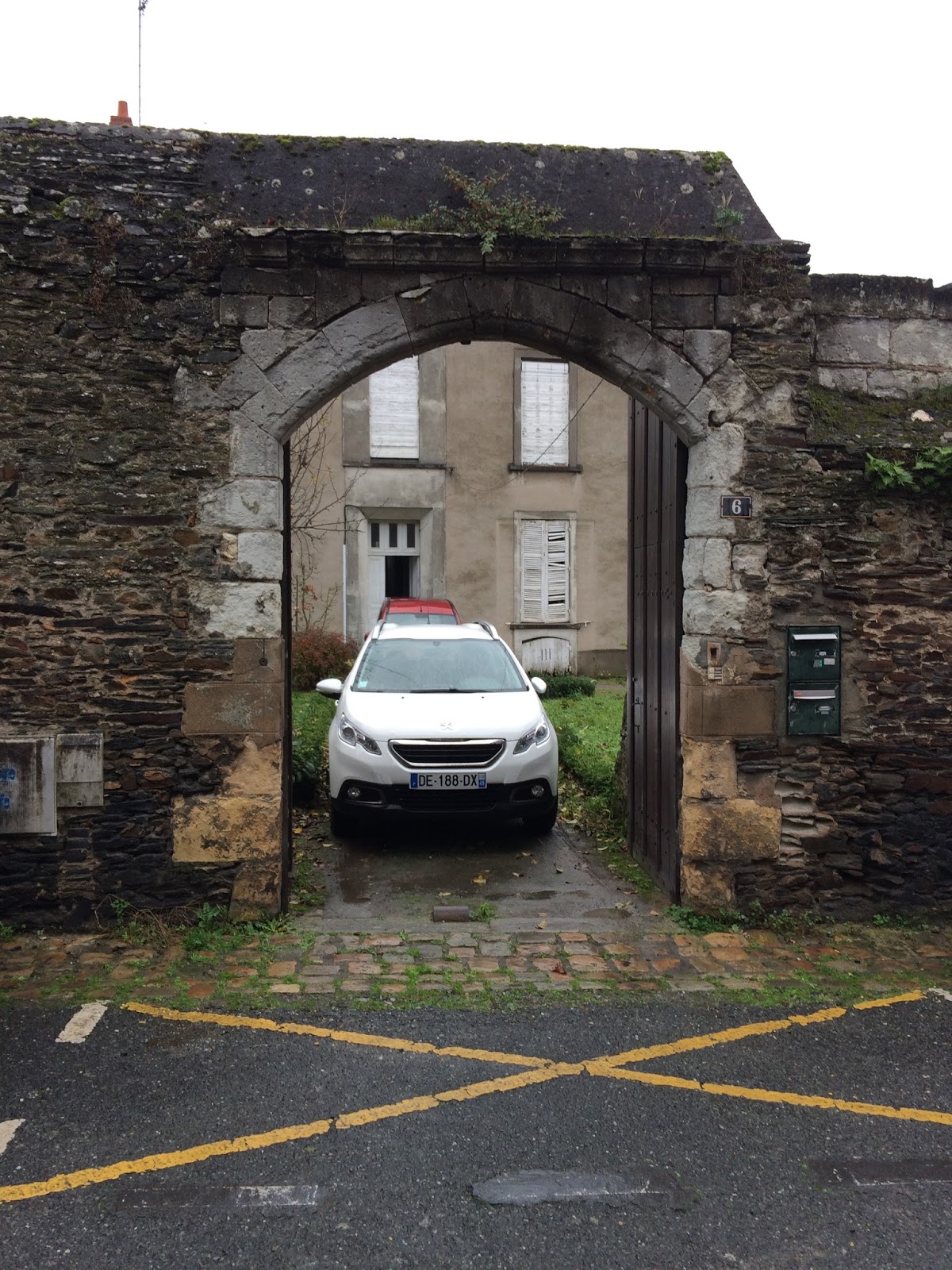
The French seem to have particularly high expectations of privacy around their family and their homes. Most homes are surrounded by high walls that block any view of the grounds. You never know what is hidden on the other side of a wall or gate. It could be a grand mansion with a carefully tended garden or it might be an old decaying house that has been broken into cheap apartments with rotting shutters and a courtyard full of weeds.


Joan raising the roll-up shutters in the morning.
Most homes (including apartments) have working shutters that are closed each evening and opened each morning to keep out prying eyes. Modern homes and apartments typically have roll-up shutters that can be raised or lowered from the inside with a switch or a handle. In the evening, you don't have to look outside to know that the sun is going down because you can hear all of the shutters closing.

Apartment building in the morning
as residents raise their shutters
All the shutters closed for the night, but they will be open
in the morning.
Unlike Americans, the French also are careful to keep their conversations private from people around them. Although restaurants, tend to be small, with tables packed closely together, it is very unusual to hear even bits and pieces of the conversation at an adjoining table because the French are careful to keep their voices low. You can always tell when there is an American in the restaurant (or train station or other public place) because you can hear their conversation across the room. Even at home, the French seem to be quieter than Americans. We have stayed in several apartments in France, and our house shares commons walls with neighboring homes, but we have rarely heard our neighbors. 

French norms of acceptable conversation and behavior are also significantly different than in the United States. In general, unless you are a close friend or family, it is inappropriate to use a person's first name, use familiar pronouns or ask about their personal life. It is considered an invasion of privacy to ask an acquaintance what they do for a living. It is like asking them how much money they make. However, spirited discussions about religion and politics seem common.

Another area of difference relates to the role of the government in protecting privacy. Tough privacy laws (with civil and criminal penalties) protect the personal life of all French citizens, including politicians and public figures. Basically, it is a violation of the law to write about or take pictures of the personal life of a French citizen without permission, even if the behavior occurs in a public place. Thus, courts have ruled that it was illegal to write about extramarital affairs of the President of France and that it was illegal to take a picture of a British royal sunbathing. However, most French seem to be unconcerned about changes to the law that allow electronic surveillance, monitoring of email or searches without warrants. Of course, like many in the United States, the people who are unconcerned about government invasions of privacy seem to assume that the government will only invade the privacy of terrorists and illegal immigrants. Perhaps the French trust their government more than Americans.


Sunday, December 6, 2015

The Peloton Dream

2012 Tour de France
One of my dreams has always been to race in the Tour de France.  At this point in my life that seems unlikely to happen, but I have been enjoying cycling around the French countryside. It has been a wet Autumn so opportunities to take long bike rides without getting wet have been limited. On most days we have been more likely to be sitting in front of our fire than riding our bikes in the rain. At best, Joan and I have been about do a short bike ride between rain showers.

Joanie on local bike trail
Yesterday, was a beautiful day so I took the opportunity to slip out for a ride. The outbound ride was nice, but uneventful. I followed the bike paths up the Maine, and Mayenne Rivers. Although the paths were still muddy in places, I was able to average over 20 kph, which felt pretty fast on a dirt bike path through the woods.  On my way home, I decided to follow the roads, which usually means a smoother and faster riding surface, but a lot more hills. In the past, I have sometimes regretted taking the hilly route because the French don't seem to mind have a road go up a 15% grade.

The decision to take the hilly route turned out to be a great decision because just as I was starting down a long hill, I was passed by some motorcycles labeled "Sécurité". As I approached the next intersection, I noticed that the motorcycles were blocking the traffic in the intersection for me, which seemed kind of nice. I remarked to myself that they really are nice to foreigners sometimes. Eventually, it began to dawn on me that they might not be blocking the intersections just for me.

Shortly thereafter the lead group of cyclists in their spandex outfits caught up to me on their fancy road bikes. With them breaking the wind for me, it was relatively easy for me to draft behind them down the hill at 50 kph. It was the first time I had really wanted a higher gear because I was having to pedal fast to stay up with them. The lead cyclists were young and they seemed to think that it was funny that a guy in street clothes pedaling a city bike with fenders and lights was keeping up with them. They chided the lead rider to go faster, but with them breaking the wind and a slight downhill grade, they were not able to shake me.

After a couple of minutes, the rest of the group (about 20 riders) caught up to me, They seemed to think that it was less funny that I had somehow gotten in the middle of their training session, and some of them boxed me in and forced me to the rear of the pack.  However, they didn't seem to mind having me hang onto the back of the group.

The group almost shook me on a couple of climbs but I was relatively fresh and determined to stay with the group.  I managed to stay with the group all the way back to Angers. I have to admit that it was kind of nice to be able to speed through towns with people blocking the intersections for you and a pack of riders breaking through the headwind. The net result was that on the ride home I covered 40 kilometers in about an hour (averaging about 25 mph), which may not sound very fast, but it is definitely the fastest ride I've had in France. It may not have been the Tour de France, but it gave me a little taste of what it might be like to ride in the peloton.

Today my stiff body is reminding me why I don't normally ride that fast.

Sunday, November 22, 2015

Normandy, Freedom and Terrorists


Omaha Beach in Normandy
It has been 10 days since the terrorist attacks in Paris, and the reaction in France has been similar to the reaction in the United States after the 9-11 attacks: fear, shock, anger, patriotism and talk of draconian responses. People have put candles in their windows, military enlistments are up, and the newspapers are full of "news" relating to the attacks. We have seen more military personnel in public places and we have even seen a police roadblock. Some of the politicians in the U.S. and France seem to want to use these attacks as an excuse to curtail liberty and freedom that have long been the hallmark of both nations. In the ten days since the attacks we traveled to Normandy and I've attended my evening French classes, which are mostly made up of Muslim immigrants and both of these experiences have affected my response to the attacks. 


The trip to Normandy reminded me that 54,000 young men sacrificed their lives to safeguard our liberty and freedom during the battles to establish a beachhead in France and defeat Nazi Germany. Including injuries,  there were 425,00 casualties during the Battle of Normandy. After seeing the battle scarred bunkers, and the fields of graves, it seems inconceivable to me that politicians would allow a handful of terrorist to cause us to give up fundamental rights that hundreds of thousands of young men fought for on the beaches and fields of Normandy.

German guns along the coast of Normandy
My French classes, which are filled with immigrants from many different nations, but mostly poor refugees from Muslim countries in Africa and the Middle East, have given me an appreciation for plight of the typical Muslim in France. When we came to France I was not expecting to be meeting refugees from Syria, Somalia, Libya, Iraq and many other war-torn countries, but it has made the experience of being in France much richer and more interesting than I anticipated. Most of the Muslims I have met seem to be trying to build a new life in a country that provides them with opportunities not available in their home country. 

We think of the United States as a melting pot of different nationalities, but I did not realize that modern France is a modern melting pot. I wish that the politicians proposing to suspend civil liberties and "crack down" on immigration would spend more time talking about the advantages of accepting immigrants from many different cultures. 

I should confess, however, that the thought has crossed my mind that some of my classmates could be terrorists. I don't really have any evidence to support these suspicions, but I suspect that my ignorance of their experiences and culture is a fertile ground to breed fear and suspicion. The large number of refugees is a little scary. My ability to communicate with my classmates is limited by our mutual inability to speak French (they don't speak English and I do not speak their native languages). To the extent that I have been able to learn their stories, their stories are inspiring, but the large number of refugees is a little scary. 

After ten days to reflect on the terrorist attacks in Paris, I am resolved to get to know the Muslim immigrants in my classes and learn their stories. I am also committed to do everything I can do to speak out against misguided attempts to use the terrorist attacks to restrict our liberties and freedom. Most importantly, I agree with the sentiment expressed in Paris that we should not be afraid.  We should not live in fear of terrorists and we should not allow our leaders to use fear to justify repressive policies that are contrary to ideals that lead to the founding of republics in France and the United States.


Demonstrations in Paris after the November attacks

In conclusion, I want to share two quotes.  First, an excerpt from the New York Times (which was brought to my attention by a French businessman):
France embodies everything religious zealots everywhere hate: enjoyment of life here on earth in a myriad little ways: a fragrant cup of coffee and buttery croissant in the morning, beautiful women in short dresses smiling freely on the street, the smell of warm bread, a bottle of wine shared with friends, a dab of perfume, children playing in the Luxembourg Gardens, the right not to believe in any god, not to worry about calories, to flirt and smoke and enjoy sex outside of marriage, to take vacations, to read any book you want, to go to school for free, to play, to laugh, to argue, to make fun of prelates and politicians alike, to leave worrying about the afterlife to the dead.
No country does life on earth better than the French.
Paris, we love you. We cry for you. You are mourning tonight, and we with you. We know you will laugh again, and sing again, and make love, and heal, because loving life is your essence. The forces of darkness will ebb. They will lose. They always do.
Finally, a Ben Franklin quote (which Rebecca Wallace reminded me about in a comment below, but I felt needed a more prominent spot in the blog):
”People willing to trade their freedom for temporary security deserve neither and will lose both.”


Friday, November 13, 2015

Le Loire à Velo (My bike trip down the Loire valley)

Overview of Trip

Map of bike trails along the Loire River

Prior to coming to France, one of my dreams was to travel around France by bicycle. It has been my experience from previous bike trips that traveling by bicycle is a great way to get to know an area because it brings you into contact with more local people and forces you to speak the local language.

Over the last couple of months I have been making day trips around the region so the next step was to make a mult-day trip. I decided to begin with four days of cycling down the Loire River. The original plan was to cycle from Gien to Angers, cycling about 100 km per day (including sightseeing detours). In 1980, I cycled 100-180 miles per day on a cross-country trip across the United States so 100 km per day (about 60 miles per day) sounded easy. My brain tends to forget that the surrounding body is not as young as it used to be and sometimes my brain writes checks that my body is is not able to cash, ... or just barely able to cash. Fortunately, an adverse weather forecast prompted me to scale back my plans.

Day 1 - Angers to Orléans (by train) to Beaugency (by bike)

Early morning departure in a misty rain

My trip began with short bike ride to the train station in a cool misty rain over wet cobblestone streets. My goal was to get myself and my bike on an 8 am train from Angers to Orléans. The railroad web site indicated that the trains along the Loire have six spots to store bicycles which can be reserved, and I had tried to reserve one of those spots when I bought my ticket a few days earlier, but the ticket agent said that it was impossible to reserve one of the bike spots. At least I think that is what the ticket agent said. I haven't exactly mastered French yet.

Actually, I had a really hard time communicating with the ticket agent. Although I had prepared a script of what I would say, and rehearsed the script, my pronunciation of the words was unintelligible to the ticket agent.  Furthermore, the ticket agent's responses didn't follow my script. Things went off track during the first few words of the conversation. It took me a long time to communicate the name of the city where I was going since I apparently was unable to pronounce "Orléans" in a way that any French person could understand. I was pretty sure that I eventually succeeded in communicating to him that I wanted to reserve a spot for by bicycle on the 8 am train to Orléans, but I could see no indication anywhere on my ticket that I had a bicycle.

On the morning of my departure, I approached the train platform with apprehension. Some blogs warned that the bike racks were often full and that conductors would throw cyclists off the train if the bike racks were full. Thus, I arrived early at the train platform prepared with the French phrases I might need to claim my spot on the train. (I also rehearsed how to properly say "Orléans".)  However, my fears were unnecessary, the conductors were exceptionally helpful. They directed me to a car with the one remaining open spot for a bike. Two hours later, I was at the train station in Orléans. Things were going great, but things were about to take a turn for the worse.

There was still a misty rain falling from the sky when I arrived at the train station in Orléans.  After checking the weather on my phone, I decided go straight to my destination and to skip sightseeing in Orléans (lots of monuments to Joan of Arc's victory over the English) because the weather forecast was for harder rain showers in the afternoon and I wanted to get to my destination before the hard rain began. Because it was wet, I decided to turn off my phone in order to conserve the battery and bury my phone in layers of waterproof bags. These turned out to be bad decisions.

In my haste to stow the phone and hit the road, I somehow managed to lock the SIM card on my phone and the message on my phone said that I needed to contact the carrier to obtain my PUK code to unlock the SIM card.  After attempting to get the code from the carrier and failing, I was pretty depressed. My phone had become almost useless. So much for my ability to pick up the phone and call for help if I encountered problems. Unless I could find a public Wifi signal, it also meant that I was losing access to various services I had been counting on using while on the road, such as Google Maps.

Bridge across the Loire in Orléans
In a spirit of frustration, I rocketed out of the train station onto the wet cobblestone streets of Orléans hoping to get to Beaugency (my destination for the night) before it started raining hard. The fine mist quickly coated my glasses making it difficult to see. Without the assistance of Google maps, I quickly became disoriented in the narrow streets and fog, ... so I pedaled faster ... taking myself faster and further in the wrong direction. Before long, I managed to get my rear tire caught between some cobblestones, which almost resulted in a catastrophic crash. When I picked myself up, I discovered that I had damaged the rear wheel and pulled the tire off of the wheel. I also broke the mount for bike pump and a few other minor parts. Fortunately, although I was sore, I was not seriously hurt. As I sat in the rain trying to fix everything, I was tempted to catch the next train back to Angers, but after remounting the tire and truing up the wheel, I set out again for Beaugency - thoroughly wet but determined to persevere.

The chateau in Beaugency
After the disastrous start to my ride, cycling in the rain seemed like a minor annoyance. Although I held my breath a few times when my heavily laden bike I hit potholes hidden by leaves, or I skidded on wet leaves, things began to get better. Eventually, the rain stopped and I raced against a fresh wind to beat the next line of storm clouds to Beaugency. By the time I arrived in Beaugency, I was tired, but almost dry.

The hotel I had booked in Beaugency took me in despite my forlorn appearance. They were exceedingly kind, but I guess that they had plenty of experience with road weary guests. The hotel opened for business in 1299. After the rain passed through town, I even had time to do some sightseeing and eat an excellent dinner.

What had I learned on my first day of riding? First and foremost, there is no point rushing, it just seems to create more problems. I vowed to "smell the roses" more the next day. Also, I realized that I packed too much. Everything would have been a lot easier if my bike packs were about 20 pounds lighter. Perhaps it had been unnecessary to bring 2 guidebooks on the Loire Valley, one 1000+ page novel, and a fresh change of clothes for every day. On the other hand, as I cycled through the rain, I was happy that I had brought my rain gear and that I had a bike with fenders and lights.

Day 2 - Beaugency to Amboise

Bike trail on an ancient levee

After a good night's sleep and a great breakfast, I was ready to take on the road again. The morning was beautiful and the air was crisp. It was going to be a beautiful fall day. My goal was to make it to Amboise, which was about 80 km downriver (assuming that I didn't get lost). 

The first couple of hours were glorious. The bike path was smooth and almost level. For the most part the bike trail was along the crest of the levee under a tunnel of small trees which sheltered the trail from the wind. I managed to knock off the first 24 kilometers in an hour. 

Saint Laurent Nuclear Power Plant
By 11 am, I had passed a nuclear power plant (the first of two I would pass on the Loire River), and I was in Blois. I was already calculating that I could be at my destination by 1:30 pm if I kept up the pace. So much for smelling the roses. 

Crossing the Loire in Blois
I decided to force myself to do some sightseeing. After wandering around checking out the churches and chateaux in every town, I began to get tired and hungry. The catch is that the bike trail was down in the flood plain by the river, but most of the towns were up on the surrounding hillsides. I picked out a village likely to have a boulangerie (which often sell both bread and sandwiches) and set off up a very steep hill from the valley floor. Unfortunately, the only boulangerie in town was closed so I returned to the valley floor and repeated the process again at the next village ... with the same result. The third village had an open boulangerie, which was a good thing because my legs were tired of climbing hills.

Chateau for sale
After lunch, the trail got a rougher. I had been spoiled by the perfectly smooth trail sheltered from the wind in the morning. The bike trail decided to meander between the floodplain and towns and vineyards on the surrounding hillsides. When I was on top of the ridges I encountered a stiff headwind. The trails along the edge of the river tended to be muddy and bumpy. The rough trail, steep hills and wind really slowed me down. I was beginning to really regret not packing lighter.

The scenery made up for the increased difficulty of the trail. I passed many interesting sights including a chateau for sale, and numerous homes built into caves in the sides of the hills (referred to in France as troglodyte homes). The chateau for sale reminded by of sleeping beauty because the entrance was blocked by a tangle of thorn bushes. I imagined that the inside of the chateau was full of sleeping servants.

Chateau de Saumur
After 86 kilometers and a few wrong turns, I made it to my hotel in Amboise in time to walk around the town and admire the Chateau de Amboise. Although the Hotel Chaptal was nothing fancy, the husband and wife who owned the hotel were particularly nice. They let me store my bike indoors in their private space and they even complemented me on my attempts at French, patiently enduring my slow attempts to find the right words and helping me with my pronunciation. When I attempted to switch to English (the wife's English was excellent) she kindly told me that I must speak French and that she would help me. At dinner, I tried to answer questions (in French) from the diners around me.

Sunset over the Loire

Day 3 - Amboise to Beaumont-En-Veron


Chickens for sale at the Sunday market in Amboise
This was the day I had been dreading. I knew that it would end up requiring require at least 100 kilometers of cycling and I was still sore from riding 86 kilometers the preceding day. In addition, I knew that the trail would take me over many hills so I decided to get an early start. When I left Amboise, they were just setting up the Sunday morning market.
The fog lifting on the road from Amboise
A dense fog descended on me as I left town and I turned on my lights to avoid being hit by a car. There was so much moisture in the air that my clothes became saturated and my glasses were almost useless. After missing a couple of turns in the fog, I started individually inspecting each corner of likely intersections for signs.The fog didn't start to dissipate until an hour later after I slowly climbed a 15% grade onto a ridge of vineyards west of Amboise. After stopping three times on the way up a relatively short climb (to take photos), I wondered if there would be enough strength left in my legs to go up the hills that I knew awaited me at the end of the day.

Chateau de Tours
When I returned to the valley floor near Tours, the fog returned. I ended up doing more sightseeting in Tours than I planned when I repeatedly missed signs in the narrow streets and fog. Eventually, I figured that it would be easier to look for the bike trail where it left the town than continually retrace my route to find a trail in the medieval streets. That turned out to be a mistake. As I exited town, I apparently rode across the bike trail in the fog and continued up a long hill before I realized that I'd missed the trail. Fortunately, the fog lifted and the signs for the bike trail were obvious when I came back down the hill. I was starting to worry that I might not get to my next destination before dark.

Sign warning of boar hunt in progress
Cobblestone bike trail!
The sky cleared in the afternoon, but it was sometimes difficult to make good time on a route that included a stiff headwind, cobblestones, and hunters who had blocked off areas to hunt for wild boar. Since it was Sunday, when almost everything in France is closed, I never succeeded in finding a place to eat lunch despite several detours in search of food, so I subsisted on nuts and an orange from my bag. At one point, I did see a wild boar scurry into the bushes and I was so hungry that I was tempted to chase after him.

The cash machine that ate my debit card
I was exhausted and my legs were beginning to beg for mercy as I climbed out of the valley towards farmhouse where I had booked a room for the night. At the top of the hill in the town of Avoine, I decided to use a cash machine to make sure that I had enough money to pay for dinner and the night's lodging (in the countryside of France you can not count on being able to use a credit card). Unfortunately, the cash machine was uncooperative and it decided to eat my debit card. This was really depressing. The bank would not reopen until Tuesday.

When I booked a room at a location at a farm in the country, it seemed like a great idea but I forgot that almost nothing is open on a Sunday afternoon or evening in France. I asked the owner about my prospects for finding an open restaurant or food store, but she was not optimistic. She thought that my best chance might be in Chinon, which was about 10 km away, but she was skeptical about my chances and she offered me eggs from her chickens if I was unable to find anything open. After riding 106 km, I was not excited about the idea of getting back on my bike to make a 20 km round trip in search of an open restaurant or grocery store, but I was really hungry.

I decided to try the nearest villages first - no luck. Everything was closed except the vineyards. As I rode the 10 additional kilometers to Chinon, I passed lots of open vineyards, but nothing was open that served food. I scoured Chinon twice in search of food, but nobody was serving food. The handful of places that were open on Sunday didn't serve food until after 7:30. I could order beer, wine or coffee before 7:30 pm, but not food. I was tempted to drown my sorrows in beer until the kitchens opened at 7:30 pm, but I didn't want to ride back in the dark so I reluctantly set off towards the next town even though my body was telling me that it couldn't go any further.

I prayed for a miracle. To my amazement, a McDonalds appeared out of the mist. Thank God for American fast food. The clerk at McDonalds looked at me like I was crazy when I ordered a hamburger at 4:30 pm. All the French people in McDonalds were just having coffee. Nonetheless, the manager reluctantly fired up the grill just for me. They probably wondered what type of heathen eats at the uncivilized hour of 4:30 pm.

As luck would have it, on my way back to the farmhouse from McDonalds, I stumbled upon a dilapidated house with a sign in front that said "Creperie." Since the "meal" at McDonalds was not entirely satisfying, I knocked on the door and asked if the creperie was open. The owner was very kind, and fixed me a crepe - ham, eggs and cheese melted over a buckwheat crepe. It was delicious. The owner asked if I wanted anything else (at least I think that is what she asked), and in my broken French I told her that I'd like a second crepe just like the first one. She asked if perhaps I wanted a dessert crepe or coffee and I repeated that I really just wanted another savory crepe. She shook her head at the odd eating habits of Americans (remember, it is still only 5 pm, well before any civilized person would eat dinner). After another crepe followed by two scoops of her homemade ice cream, I headed back to my lodging - La Balastière - finally making it back just in time to sit in the courtyard and enjoy the last few rays of sun. My search for food had added a bonus 24 km to my day's ride. At that point, I never wanted to see a bike seat again. 
La Balastière

Day 4 - Beaumont-En-Veron to Angers


All for me. There were not other guests.
Monday morning was the most beautiful morning of the trip. The sky was blue, the winds were calm (at least initially), a beautiful farm breakfast awaited me, and I knew that I would be sleeping in my own bed at the end of the day (even if it meant taking the train home). After a couple of small bike repairs, I was packed and on the road by 8:30 a.m.

Entry to underground "troglodyte" village.
Note doors and windows on left.
The ride though the hills and vineyards was spectacularly beautiful. There seemed to be a chateau on every hill and a 13th century church in every village. Vineyards were everywhere. The bike path followed ancient canals and went underground to pass through a troglodyte (cave) village. 

Ancient canal
Sign warning of 12% grade
There were also a lot of 12% and 15% grades. I found myself lusting for gear on my bike low enough to easily climb a 15% grade with a 30 pounds of gear.

Two routes to Saumur
In some places signs along the trail gave two options to get to the next town. I quickly learned that the shortest route was not always the easiest of the fastest. Even it was longer, the route "par les bords de Loire" was probably going to be flatter than the route "par les coteaux." After picking the shorter "coteaux" route a couple of times and enduring painful 15% climbs, I decided to stick to "les bords de Loire." By afternoon, I decided to try to further shorten the time by trying to cut out a few of the unnecessary twists and bends in the bike trail and to skip some of the remaining hills. The trick was figuring out which bends in the trail avoided a hill and which bends in the trail took you up a steep hill to see something scenic. More than once my "shortcuts" probably added time to the trip.

One of the highlights of the afternoon was seeing the first sign for the town where we are living - Angers. At this point, I knew that there was less than 40 km left and that I could conceivably be home in 2 hours.  Unfortunately, things didn't work out that way. The bike trail to Angers took me through ancient slate quarries (Angers is famous for slate). These quarries presented a maze of trails that alternated between mud and loose piles of shale. Just when the trail seemed to become impassable, I would find another sign indicating that I was on the trail. It might have been fun on a mountain bike, but it was torture on a heavily loaded touring bike.

Home sweet home
Eventually, I made it home. The cobblestone street in front of our house never looked so good. Before I unloaded my bike, I ransacked the kitchen for food (two pieces of chocolate cake and a beer were a good start). 

All-in-all, I would declare the trip a success. I pushed myself physically, and it forced me to get outside of my comfort zone and speak a lot of French (or at least what I call French). I also saw a lot of beautiful scenery and met some wonderful people (who I was forced to speak to in French). However, my body is not the same as it was 35 years ago. It might be a few days before my sore joints recover and my memory dims enough to start planning my next big bike trip. Once my memory of the exhaustion dims enough to start planning the next trip, I will make sure to pack lighter and I will also make sure to have the unlock code for my SIM card.

To anybody considering a bike trip in the Loire valley, I heartily recommend the bike trails in the valley (Le Loire a Velo). Despite my mishaps, it is the best network of bike trails that I have ever seen. Autumn is a wonderful time to visit the Loire valley, with the autumn leaves and relatively few tourists.  Just make sure to leave more time to smell the roses than I did and don't book a place in the countryside on a Sunday evening unless you pack in your own food. Packing light is also recommended.


Sunday, November 1, 2015

A Week in Provence

Palace of the Popes in Avignon
It hasn't exactly been "A Year in Provence" but it has been a week.  If you have never been to Provence, it is a difficult place to describe. The climate is a little like south Florida, except with Roman ruins and better food. Provence is a great combination of the culture of Italy, Spain and France with a lot of retirees and tourists. If we spent more time here I think that we would also find that there area lot of Islamic and African influences hiding beneath the surface. The back streets of the larger cities seem to be full of kebob restaurants and women in hijabs.

Provence has a wonderful climate, medieval fortresses, a palace for the popes, a wide variety of scenery and wildlife, and some of the best preserved Roman structures in the world  (I can't call them ruins because they are in remarkably good shape and many of them are still in use for their original purpose).  They also have some great food and wine.

Rice paddies in front with gite in the background
We have spent the week staying in a gite on a farm that grows olives, grapes and rice. The combination of crops might seem unlikely until you see the network of irrigation canals that enables them to grow rice in flooded fields next to hillsides of grapes and olive trees. The ruin of an ancient abbey is visible on the next hill and a Roman viaduct is just over the hill. I get the feeling that life here has not changed tremendously since Roman times. The biggest difference may be that today's barbarian hordes bring gold instead of plundering gold. Tomorrow, we return to the cooler climate of the Loire Valley.

My advice for anybody visiting Provence is to spend at least a week in Provence, ... but a year would be even better. There is a lot to see and it takes time to soak up the ambiance.
Roman Arena in Nimes (still in use)

One of two Roman temples in Nimes

Flamingos in the Carmargue

Fortress of Les Baux

Joan in Roman Theater in Orange

Pont d'Arc in Ardeche Gorge
Roman Arch in Orange


Wild goat in Ardeche Gorge